
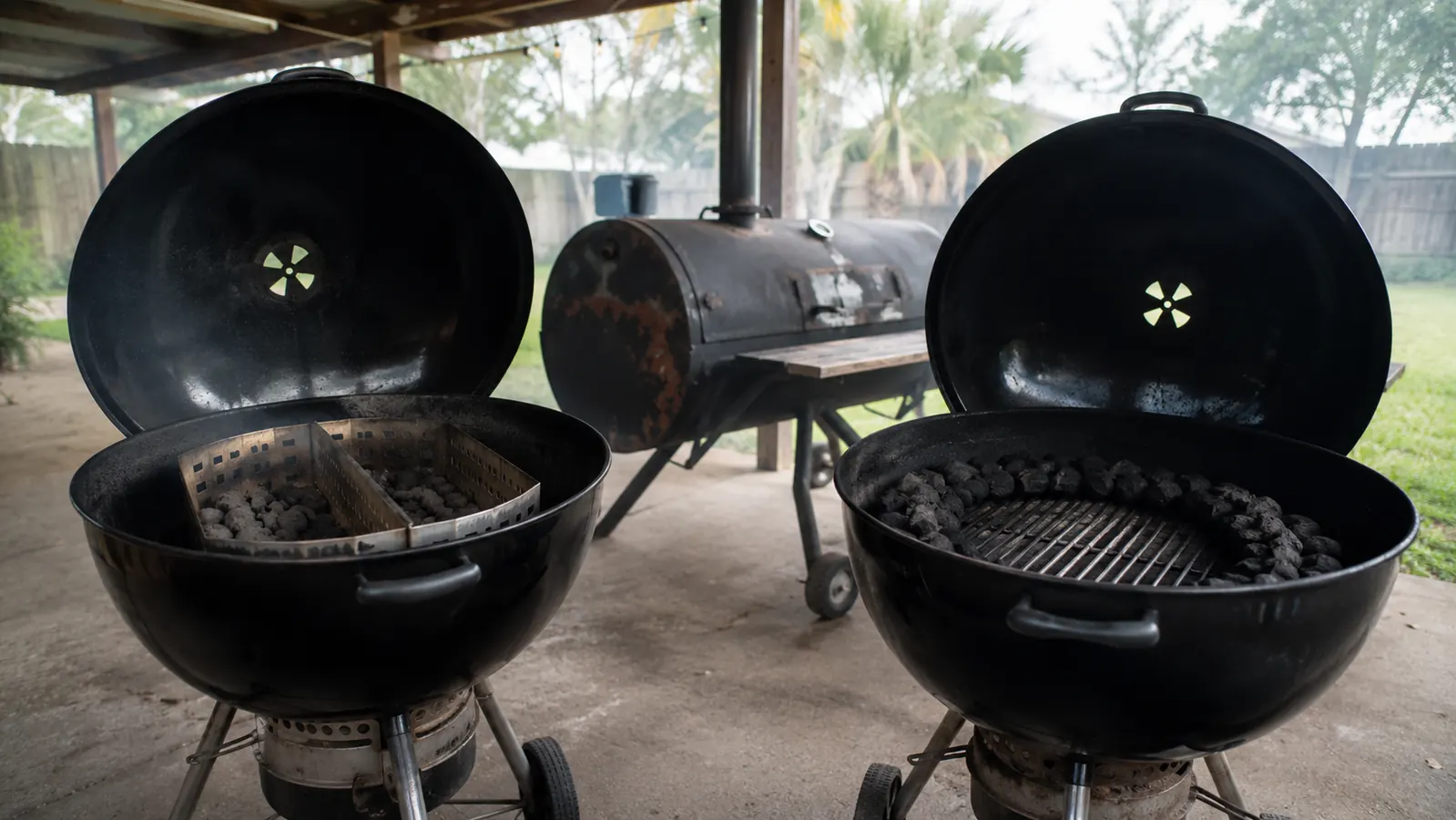
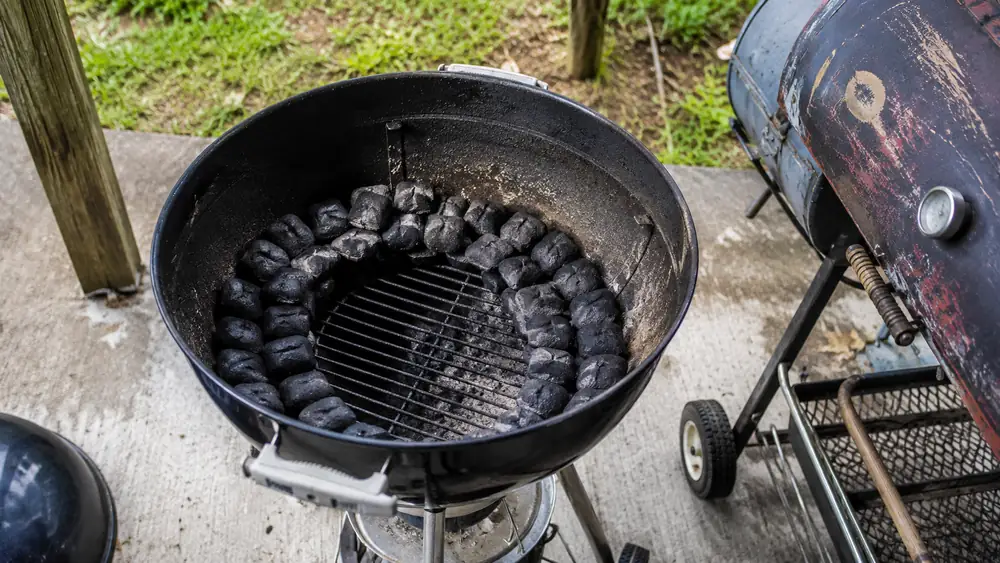
If you've spent any real time around a kettle grill, you already know the charcoal snake method. You lay briquettes in an overlapping ring around the inside wall of the kettle, light one end, and in theory the fire creeps around slow and steady for eight or ten hours without you touching it. I ran that setup on my 22-inch kettle for close to two years, and it worked, right up until a gust off the bay knocked a section of my snake sideways at two in the morning and cost me a brisket I'd been tending since before sundown. That's the night that sent me shopping for a Slow 'N Sear, the stainless charcoal basket insert SnS Grills builds for 22-inch kettles, and it's lived in my grill for nearly every low and slow cook since. This is an honest side by side of the two, because the snake method still wins in a few places that matter.
Short answer, if you want it up front: if you cook in real wind, humidity, or you want to actually sleep through an overnight brisket, the Slow 'N Sear earns its keep. If you cook somewhere calm and covered and don't mind rebuilding your fire setup from scratch every time, the charcoal snake still works fine and costs you nothing you don't already have sitting in the bag. Neither answer is wrong. They're built for different patios.
| Slow 'N Sear | Snake Method | |
|---|---|---|
| Cost to Get Started | Added purchase, one time, fits your existing 22-inch kettle | Free if you already own a bag of charcoal |
| Storage Between Cooks | Needs a dry spot, I keep mine in a tote in the garage | Nothing to store, it's just briquettes until you light them |
| Works on Any Grill Size | Sized specifically for 22-inch kettles | Scales to whatever size kettle or grill you own |
| Wind & Overnight Temp Stability | Solid stainless wall blocks wind from scattering the fire | Loose ring can collapse or burn through unevenly in gusts |
| Grease & Drippings Control | Water reservoir catches drippings, keeps the kettle bowl cleaner | Drippings hit the bare kettle bowl and build up a crust |
| Burn Line Predictability | Contained burn line, easy to read remaining fuel hours | Burn pace varies more with wind and briquette placement |
| Salt Air & Rust Risk | Stainless holds up well but screws and welds need rinsing and dry storage | Nothing metal to rust, it's consumed or swept out after the cook |
Where the Slow 'N Sear Wins
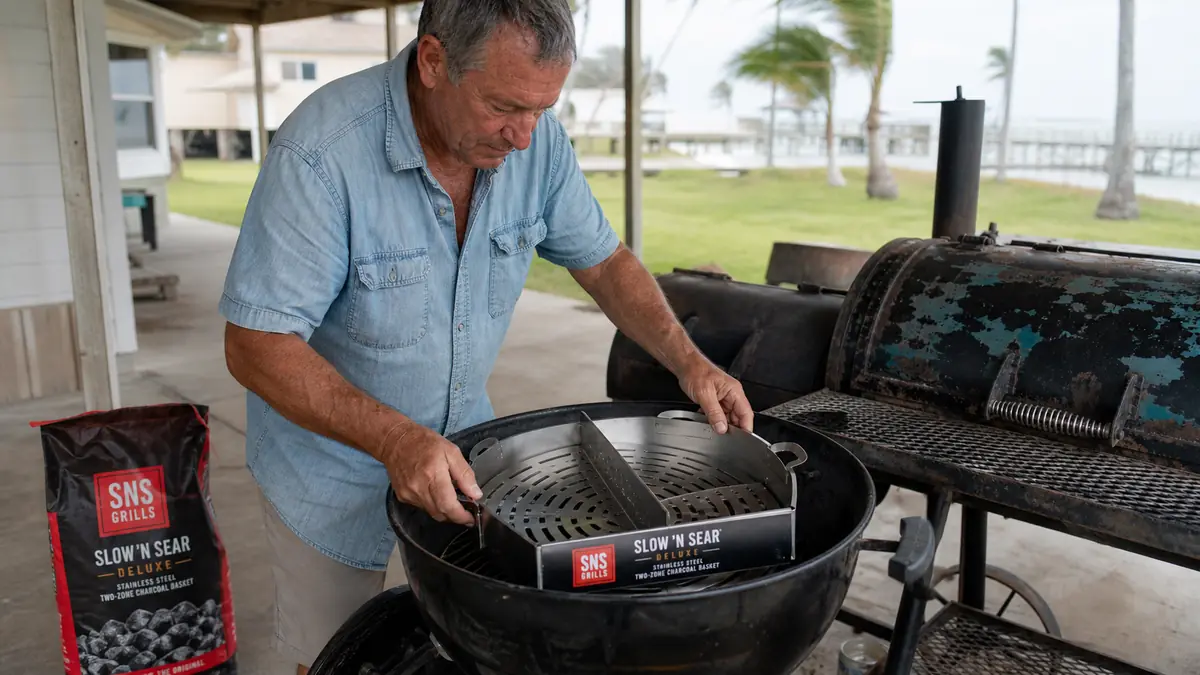
My patio sits on a concrete slab a few blocks off Ocean Drive, under a lean-to that keeps the worst sun off the lid but does nothing to stop wind coming in sideways off the bay. Corpus Christi wind does not take days off, and it especially does not take nights off, which is exactly when I'm running a nine or ten hour brisket. A charcoal snake is a loose ring of briquettes with nothing but gravity and stacking holding it together. One good gust can push it out of line or collapse a section entirely, and once that happens your temperature swings hard in one direction or the other while you're asleep. The Slow 'N Sear replaces that loose ring with a solid stainless wall. Wind can still mess with my kettle vents, and it does, but it can't scatter the fire itself, because there's steel between the coals and the open air.
The water reservoir is the other piece that tips this in the Slow 'N Sear's favor. Filled up, it acts as a heat sink that smooths out temperature swings, and it catches nearly all the drippings that used to build a hard black crust on my kettle bowl by the second hour of any pork butt. On top of that, because the unburned charcoal sits banked against the lit coals inside stainless walls instead of scattered around the kettle floor, it burns front to back in a predictable line. I can glance at that burn line four hours in and get a decent read on how much cook time I've got left, which I never could with a loose ring of briquettes.
Where the Snake Method Wins
I'm not going to pretend the snake method is obsolete, because it isn't, and it deserves credit where it's earned. It costs nothing beyond the charcoal you were already going to buy. No insert to order, no waiting on a delivery, no extra piece of gear taking up space between cooks. When I ran the snake for those two years, I stored it exactly nowhere, because there was nothing to store. The Slow 'N Sear lives in a plastic tote in my garage when it's not in the kettle, and I learned the hard way that leaving it in the grill uncovered through a wet October gets you rust freckles on the reservoir screws by Thanksgiving. If you don't want another thing to rinse, dry, and find a shelf for, the snake genuinely wins that argument.
It's also more flexible. A charcoal snake scales to whatever grill you own, from a little 18-inch kettle up to a big drum smoker, because you're just arranging briquettes differently, not buying a part sized to a specific diameter. The Slow 'N Sear is built for 22-inch Weber-style kettles specifically, so if you've got a smaller kettle or you cook on more than one grill, the snake method travels with you in a way a fitted insert can't. There's also no assembly, no clip-together panels, no reservoir to fill. You lay the ring, you light one end, you're done, and for a calm evening with no wind in the forecast, that simplicity is genuinely enough.
There's a time cost worth weighing too, and it points a different direction depending on how you look at it. Building a snake takes a few minutes of careful stacking, and you're rebuilding it from scratch on every single cook, calm night or not. Loading the Slow 'N Sear takes about the same few minutes once it's already seated in the kettle, but I'm filling a fixed stainless space instead of stacking a freehand ring, so it's a little more consistent from cook to cook. Where the snake claws that back is the day you lend the kettle to Hollis for his own cook, or your son-in-law borrows it for a weekend. There's no insert to remember to grab off a garage shelf. Everything you need for a snake ships with every bag of charcoal you'll ever buy.
Tired of Losing Sleep to a Fire You Can't Trust?
The Slow 'N Sear held a steady 225 to 250 degrees through the kind of stiff onshore wind that used to blow my old charcoal snake apart before sunrise. See today's price and current availability on Amazon.
Amazon Check Today's Price on Amazon →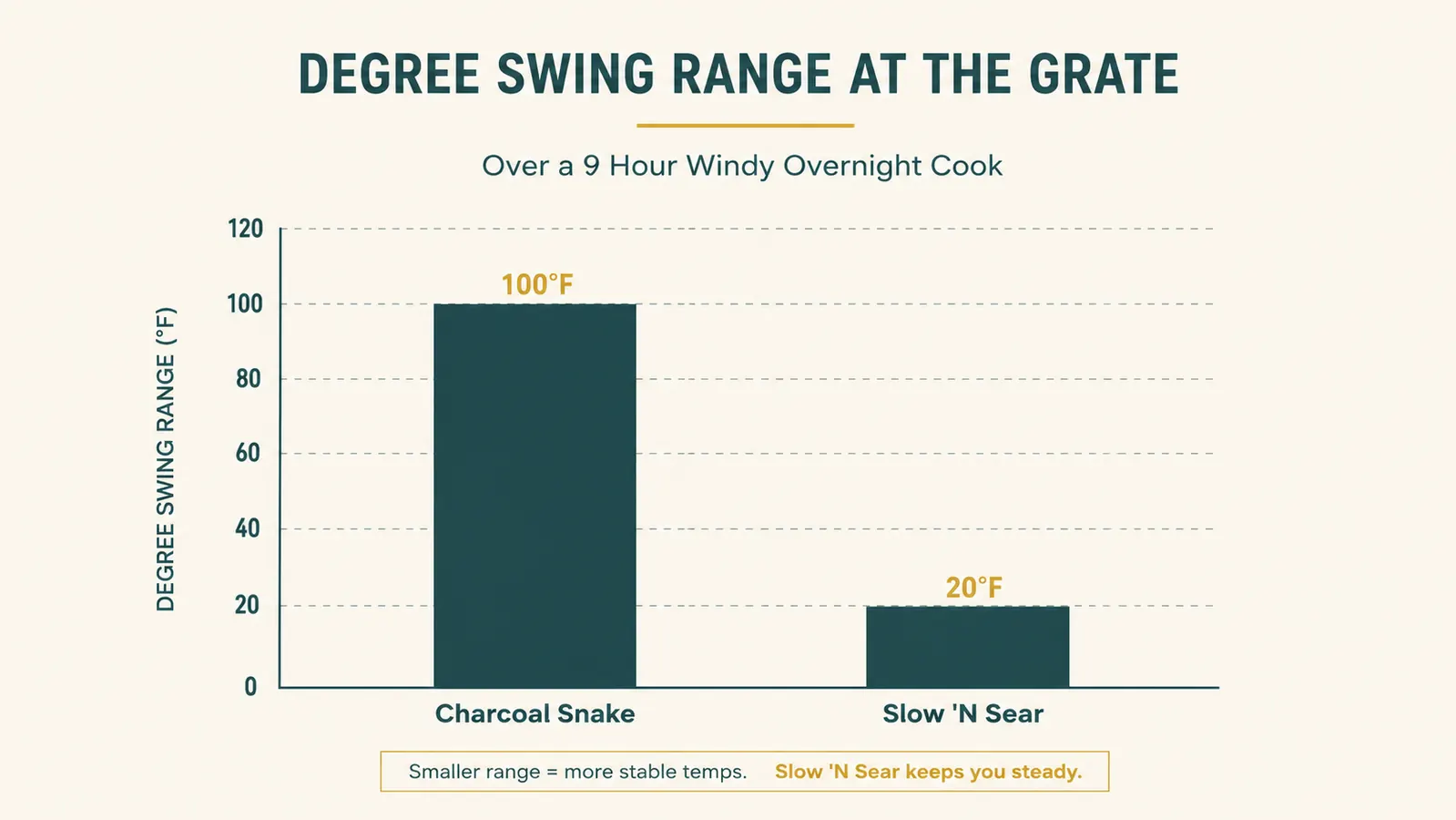
The Night the Snake Method Cost Me a Brisket
I mentioned it up top, but it's worth telling in full, because it's the whole reason I own a Slow 'N Sear today. I'd loaded a snake around nine at night for a Sunday brisket, set my vents the way I always did, and gone to bed trusting it the way I'd trusted it for two years. Around two in the morning I woke up to a wind that had picked up hard off the bay, went out with a headlamp to check the dome thermometer, and found the temperature had swung more than a hundred degrees in either direction over the last few hours. A section of the ring had collapsed and burned through fast, and another section had gone nearly cold. By the time I salvaged what I could, the brisket was tough in spots and dry in others, and Kara and Beto showed up at eleven to a Sunday dinner that wasn't what I'd promised them.
That's the kind of failure that doesn't happen once and get forgotten. It happens once and you go looking for the reason why, and the reason was simple: a loose ring of charcoal has no defense against real wind. I ordered the Slow 'N Sear that week. The first overnight cook I ran with it, I still woke up twice out of habit to check the thermometer, but both times the needle sat right where I'd left it. I've written more about how that first season went, and the maintenance side of owning it, in my full Slow 'N Sear review after a full grilling season, if you want the longer story of what three years of use actually looks like.
Fuel Use and Season-Long Cost
Over a full season the fuel math evens out more than you'd think. Both methods burn roughly the same total volume of charcoal for a given cook length, because you're heating the same size kettle for the same number of hours either way. Where I've noticed a real difference is waste. A snake that collapses or burns through unevenly in wind tends to leave scattered, partly burned chunks I end up tossing or relighting inefficiently the next time around. The Slow 'N Sear's contained burn line leaves fewer stray unburned pieces behind, and I can usually judge almost exactly how much fresh charcoal to load for the next cook instead of guessing and buying extra bags just in case.
None of that adds up to real money either way over a season, and I wouldn't tell you to buy an insert on fuel savings alone, that wouldn't be an honest argument. The bigger cost most people forget to weigh is a ruined cook. One brisket lost to a collapsed snake, plus the meat itself, plus the charcoal that burned through it wrong, plus a disappointed table of family waiting on food that isn't ready, costs more than any fuel savings either method could ever offer. That's the math that actually decided this for me.
Who Should Buy Which
If you cook where I cook, someplace with real wind, real humidity, or unpredictable weather, and especially if you're running unattended overnight cooks for a Sunday crowd, get the Slow 'N Sear. The extra piece of gear and the small amount of upkeep it asks for are worth it the first time it saves you from waking up at two in the morning to a ruined brisket. It's also the better call if you host regularly, because predictability matters more when Kara and Beto are walking in the door at a specific time expecting food to be ready.
If you cook someplace calm, or you're just getting started and don't want to spend on an insert before you know if low and slow cooking is even for you, the charcoal snake is a completely reasonable way to learn the basics of two-zone fire management without committing to anything. It's forgiving of a lot when the weather cooperates, and it costs you nothing to try this weekend. I walk through exactly how to lay one out, plus the full step by step for loading and lighting a basket insert once you're ready to upgrade, in my guide on setting up a two-zone fire with a charcoal basket insert.
A charcoal snake asks you to trust the weather. A Slow 'N Sear asks you to trust steel. Out here on the coast, steel wins more nights than not.
Ready to Stop Betting a Brisket on Calm Weather?
After that one ruined Sunday dinner, I never went back to the snake method. Check today's price on Amazon and see if the Slow 'N Sear is in stock for your kettle.
Amazon Check Today's Price on Amazon →