
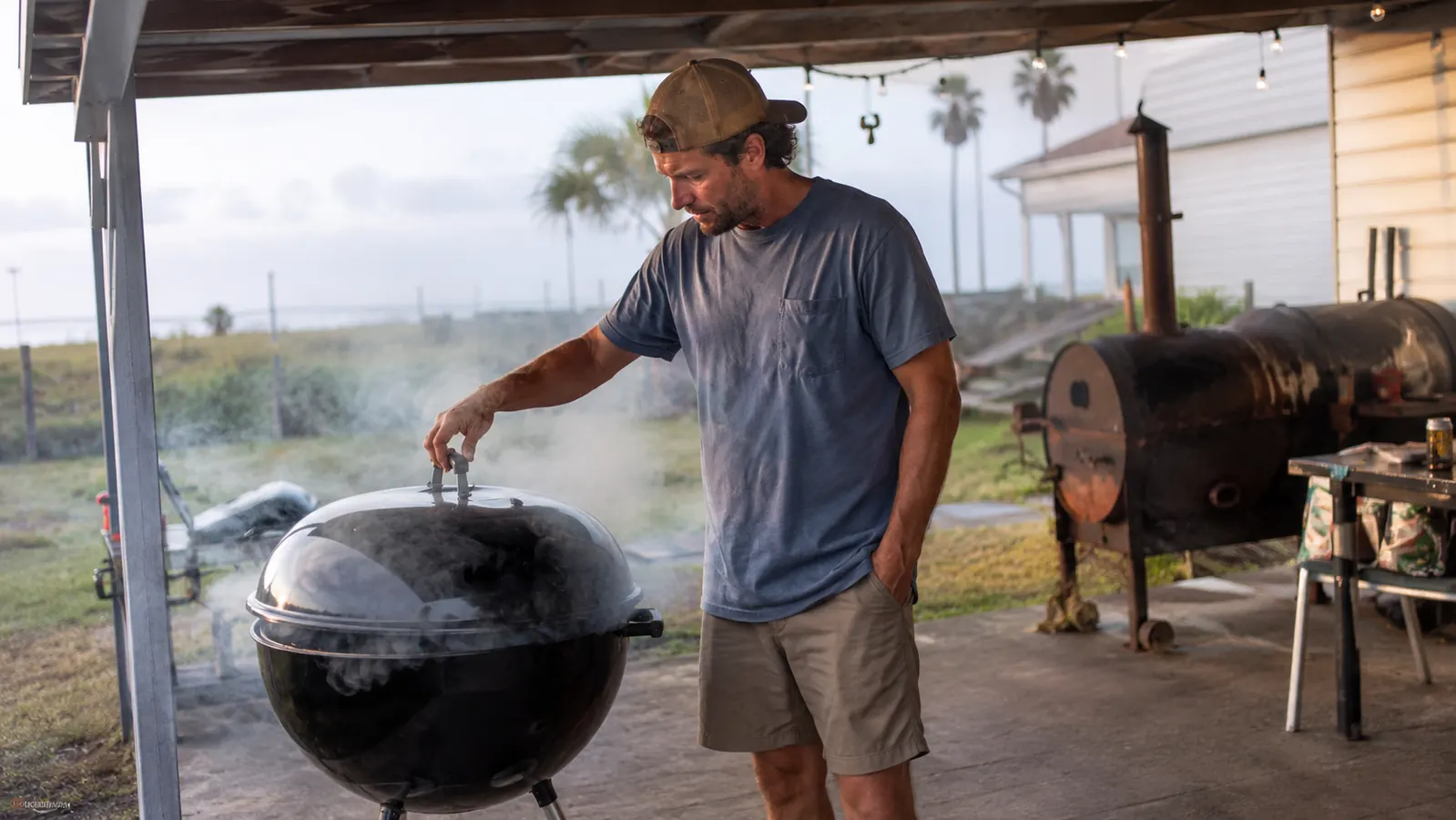
Three summers ago I was standing over my 22-inch Weber kettle at two in the morning, headlamp on, trying to keep a charcoal snake from falling apart in a gust coming off the bay, and I decided right then I was done fighting my fire instead of cooking my food. That was the night that sent me looking for the Slow 'N Sear, the stainless charcoal basket insert SnS Grills makes for 22-inch kettles like mine. I ordered it that week, and it's been locked into my kettle for every low and slow cook since. This is what three years of actual use, not a weekend test, taught me about it.
I should say up front that I'm not new to this. I've been cooking on that same kettle long enough that the handle wobbles, and I've also got a used offset stick burner out back that I bought secondhand and had to reseason and patch before it held smoke right. The Slow 'N Sear lives on the kettle, not the offset, and that distinction matters, because the two grills solve different problems for me. What follows is everything from the first brisket I ran on it to the rust spots I've had to deal with this year.
The Quick Verdict
After three years and somewhere around 150 low and slow cooks, the Slow 'N Sear earns its spot in my kettle. It fixed my temperature control problem in windy conditions almost completely. It didn't fix everything, and the water reservoir has real quirks, but I'd buy it again tomorrow.
Amazon Check Today's Price →Tired of Fighting Wind for a Steady Fire? Here's What Finally Fixed It.
The Slow 'N Sear held a steady 225 to 250 degrees through the kind of stiff onshore breeze that used to blow my old charcoal snake apart in under an hour. See today's price and current availability on Amazon.
Amazon Check Today's Price on Amazon →How I've Used It
My cooking happens on a concrete patio slab behind the house, a few blocks off Ocean Drive, close enough that on a still evening you can smell the bay. The kettle sits under a lean-to Beto helped me build two summers ago, mostly to keep the worst sun off the lid, not because I mind cooking in weather. The Slow 'N Sear stays in that kettle almost permanently now. When I'm not using it, I pull it, hose it down, dry it with a shop towel, and store it in a plastic tote in the garage with my chimney starter and a couple bags of lump. That tote habit started after I left the basket in the kettle uncovered through a wet October and found rust freckles on the water reservoir screws by Thanksgiving.
The two cooks that have put the most hours on this thing are Sunday brisket, which I run most weeks whether it's six people or twelve, and a pork butt I do every few weeks for Hollis and whichever of his poker buddies show up. Ruben, my five-year-old grandson, has started asking if the metal thing with the water in it is already in the grill, which tells you how normal this basket has become around here. Tessa is more interested in reading the dome thermometer out loud, but that's a story for another article.
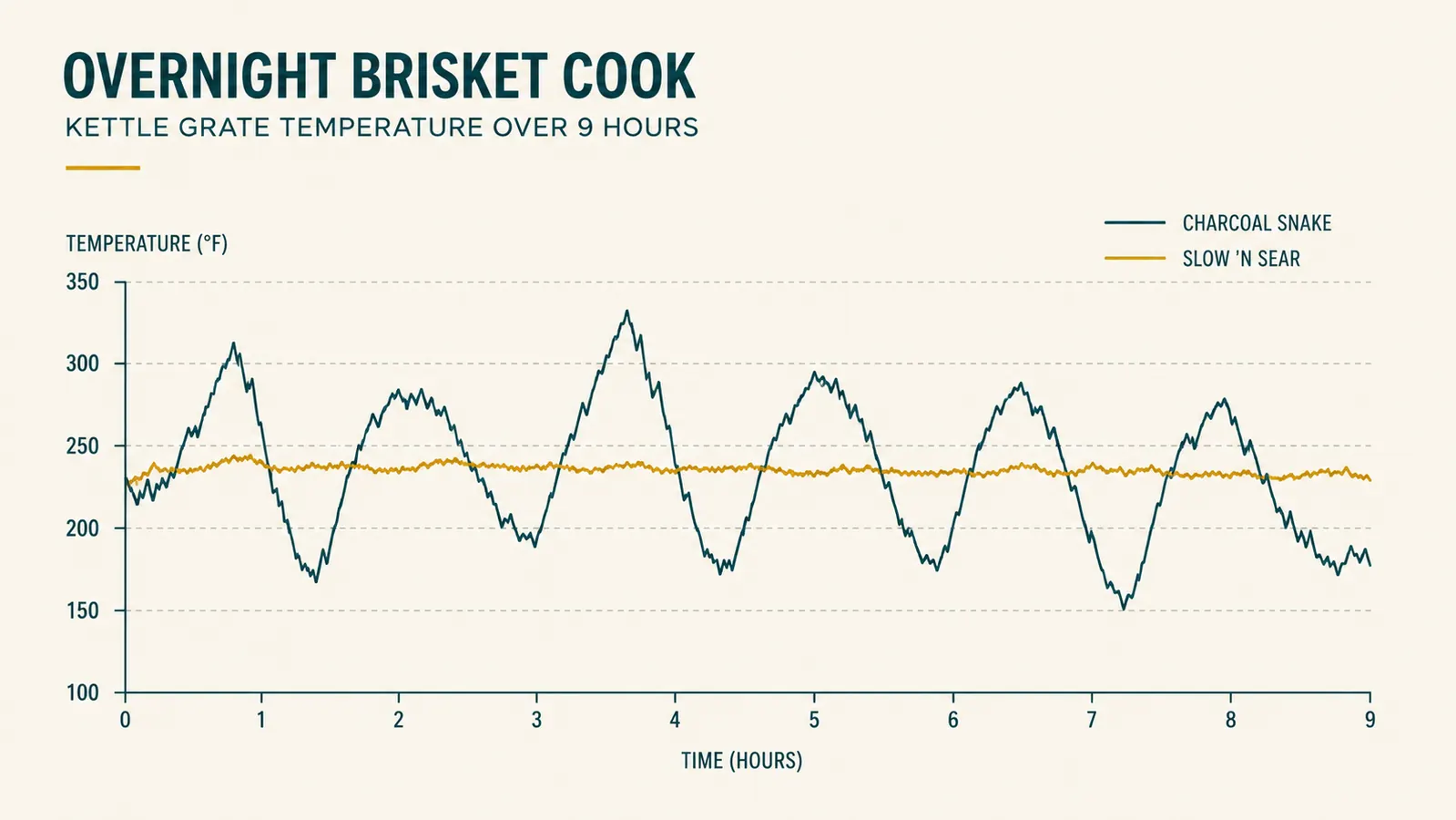
Before the Slow 'N Sear, my two-zone setup was a charcoal snake, briquettes laid end to end around the perimeter of the kettle, and it worked, sort of, until wind got involved. Corpus Christi wind doesn't take a day off. It funnels in off the bay most afternoons and picks up hard after sunset, and a snake would collapse or burn through unevenly almost every time I tried an overnight cook. I go into more detail on that comparison in my write-up on the Slow 'N Sear versus the charcoal snake method, but the short version is that wind, not marketing, is what actually sent me shopping.
The Two-Zone Setup, and Why It Matters on a Windy Patio
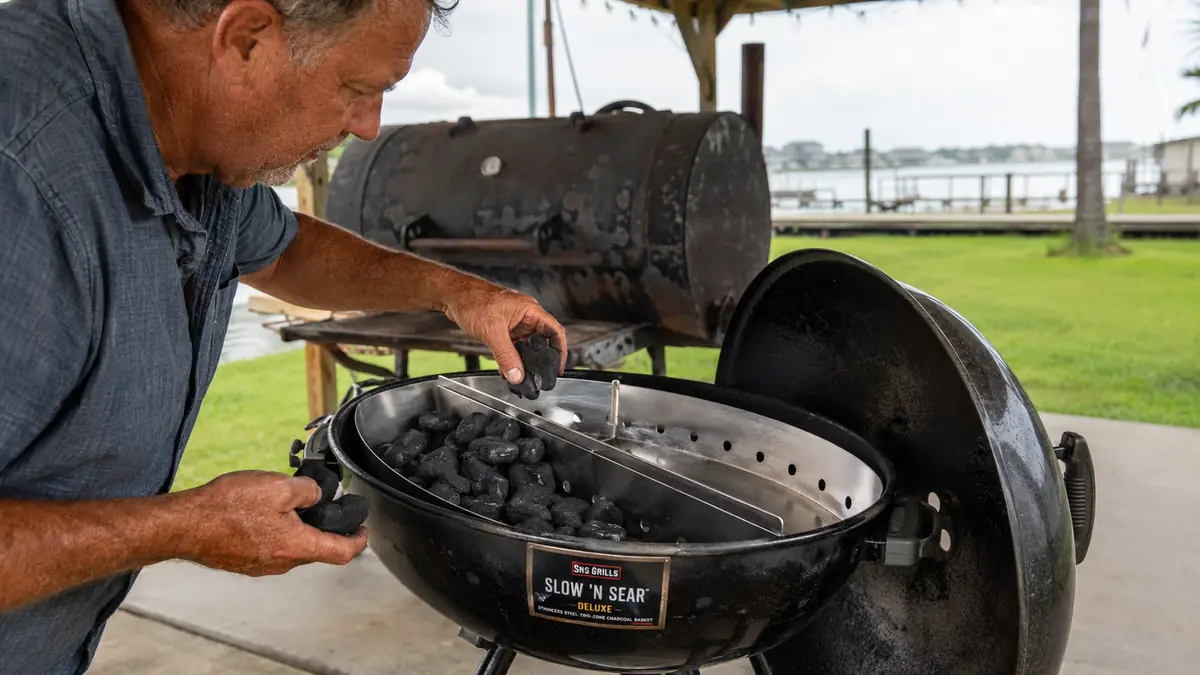
The basket itself is two curved stainless panels that clip together into a semicircle against one side of the kettle, with a water reservoir that sits behind the charcoal wall. Load briquettes or lump into the basket, add a dozen lit coals on top to get it going, fill the reservoir, and you've got a hot zone and a cool zone with a physical stainless barrier between them instead of just distance. That barrier is the difference. Wind can still mess with my vents, but it can't push heat sideways through solid steel the way it could scatter a loose ring of charcoal.
On a calm evening I can hold 225 to 250 degrees at the grate for eight or nine hours off one full load without touching the vents more than twice. On a windy one, and most of mine are windy, I still have to babysit the bottom vent, cracking it down when a gust pushes the fire hot and opening it back up when things settle. The Slow 'N Sear didn't hand me a set-it-and-forget-it cook. What it did was turn wind management into a minor annoyance instead of the reason a brisket gets ruined.
Refueling is the other piece worth mentioning. Because the unburned charcoal sits banked against the lit coals instead of laid out in a ring, it burns front to back in a predictable line, similar in principle to the snake method but contained inside stainless walls. I can look at the burn line after four hours and get a decent read on how many hours I've got left, which I never could with a loose ring scattered around the kettle floor.
The Water Reservoir: My Favorite Feature and My Biggest Gripe
The water reservoir is genuinely the best idea in this design and also the one thing that annoys me most. Filled up, it acts as a heat sink that keeps temperature swings gentler, and it catches drippings so I'm not scraping a burnt grease crust off the kettle bowl every weekend. On a long brisket cook that's meaningful. My old kettle bowl used to build a hard black crust by the second hour of any pork butt. Now most of that lands in water instead of on bare steel.
Here's the gripe. Topping it off mid-cook means lifting the cooking grate, which means losing some heat and disturbing whatever's sitting on there, and on a nine or ten hour cook I usually have to do that once, sometimes twice if it's a windy day and the water is evaporating faster than usual, which the wind absolutely does out here. SnS Grills sells a fill tube accessory for exactly this reason, and I finally bought one last year after grumbling about it out loud in front of Marisol one too many times.
What Three Years of Salt Air Did to It
This is where I have to be honest instead of just enthusiastic, because a review that only praises a product isn't worth reading. Living where I live, everything metal on my patio takes a beating. The Slow 'N Sear is stainless, and stainless holds up a lot better than the mild steel hardware on my offset smoker, but it isn't rust-proof. The screws holding the reservoir together showed surface rust inside the first year, back before I started drying and storing the basket properly. Once I got serious about rinsing it and keeping it under cover, that slowed down considerably, but I still see light discoloration on the welds every spring.
Humidity is the other Gulf Coast tax. Charcoal left in a half-used bag in the garage clumps up out here in a way it probably doesn't in a drier climate, and that affects how evenly the basket loads and lights. I've started keeping my charcoal in a sealed bin instead of the paper bag it comes in, which fixed most of that problem, but it's an extra step nobody warns you about in a product listing. If you want the full rundown on where this thing genuinely struggles, I wrote a separate, more critical piece: the honest Slow 'N Sear review covers the maintenance side in more depth than I'm going to here.
Sunday Brisket and the Pork Butt Hollis Won't Stop Talking About
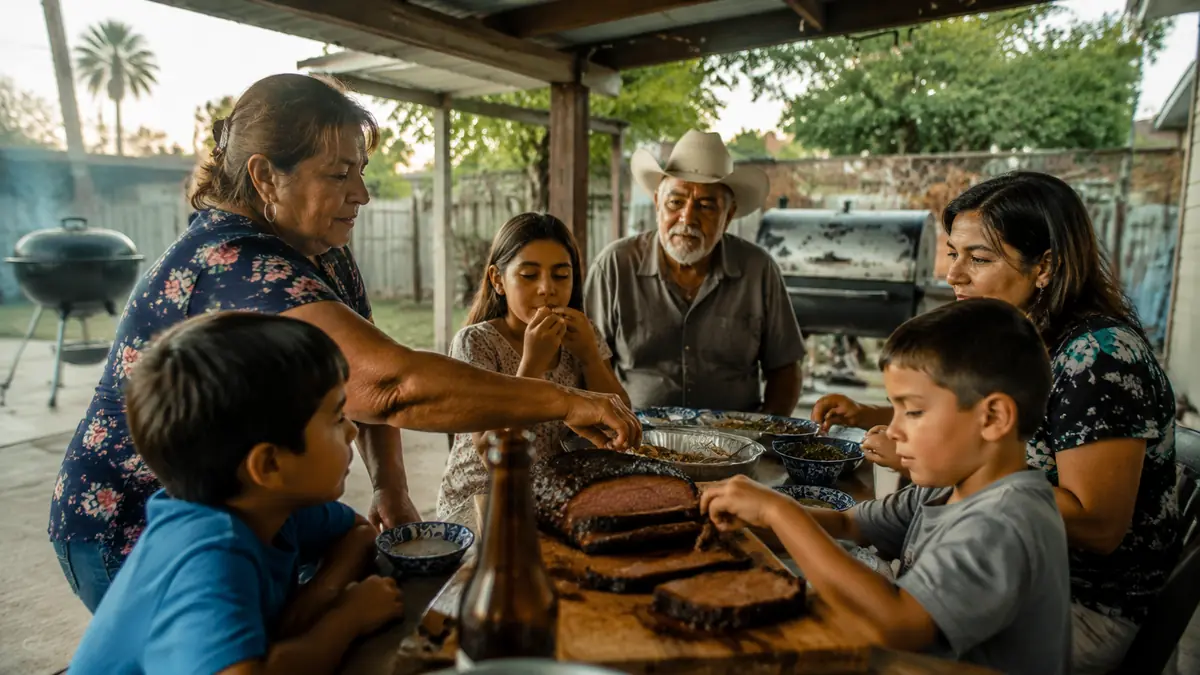
The clearest way to explain what this basket changed for me is to walk through an actual Sunday. Kara and Beto usually roll in around eleven with the kids, and I want brisket resting by one or one thirty so Ruben doesn't melt down from hunger. Before the Slow 'N Sear, that meant setting an alarm for 2 a.m. to check the snake, because I never trusted it to hold overnight through a shifting wind. Now I load the basket around 9 p.m., set my vents, fill the reservoir, and sleep until 5 or 6, checking the dome thermometer once before bed and again when I get up. Getting real sleep the night before a big family cook is worth more to me at 59 than any sear mark ever will be.
The pork butt for Hollis's poker nights is a shorter cook, six to seven hours, and it's where the two-zone setup earns its keep a little differently. I can run the smoke zone low and slow the whole time and still have enough hot coal banked to throw a few burgers over direct heat for the guys who show up not wanting pulled pork. Try doing that with a loose charcoal snake without the whole arrangement collapsing into one pile.
Alternatives I Considered
Before I bought this, I ran the classic charcoal snake for probably two years, and I've written up a full side by side of the two methods for anyone weighing it out, including exactly how the two-zone charcoal basket setup changes a normal weekend cook. Short version here: the snake is free if you already own charcoal, and it works fine on calm days inland. It just isn't built for a patio that gets wind off open water most afternoons. I also thought about building my own divider out of an old cookie sheet before I finally gave up and bought the real thing, which tells you how stubborn I can be about spending money on gear.
I didn't seriously consider a ceramic kamado, mostly because I already had a perfectly good kettle and didn't want to replace hardware that still works fine. If you're starting from scratch with no kettle at all, that's a different conversation than the one this basket insert is solving.
What I Liked
- Held steady low and slow temps through the kind of consistent Gulf Coast wind that used to wreck my charcoal snake
- Water reservoir catches drippings and keeps the kettle bowl far cleaner between cooks
- Predictable burn line makes it easy to estimate remaining fuel hours into a long cook
- Stainless construction has genuinely outlasted every mild steel accessory I own
- Fits my 22-inch kettle without any modification to the grill itself
Where It Falls Short
- Topping off the water reservoir mid-cook means lifting the grate unless you buy the separate fill tube
- Screws and welds show surface rust within a year if you don't rinse and store it properly
- Doesn't eliminate the need to manage vents in heavy wind, just makes it manageable
- Heavier and bulkier to clean out completely than a simple charcoal ring
The Slow 'N Sear didn't give me a fire I never had to think about. It gave me a fire I could finally trust enough to go to sleep.
Who This Is For
This basket is for anyone running a 22-inch kettle who wants real two-zone cooking without switching to a different grill entirely, especially if you cook in wind, rain, or humidity that punishes looser charcoal setups. If you host a crowd on a regular schedule the way I do most Sundays, the predictability alone is worth it.
Who Should Skip It
If you've got a fully covered patio in a calm climate and your charcoal snake has never once let you down, you may not notice enough difference to justify adding another piece of gear to store and maintain. And if you don't already own a compatible kettle, you're better off reading up on the grill itself before you shop for inserts to go inside it.
Ready to Stop Losing Sleep Over Your Fire?
Three years in, this is still the piece of gear that changed the most about how I run an overnight cook. Check today's price on Amazon and see if it's in stock for your kettle.
Amazon Check Today's Price on Amazon →