
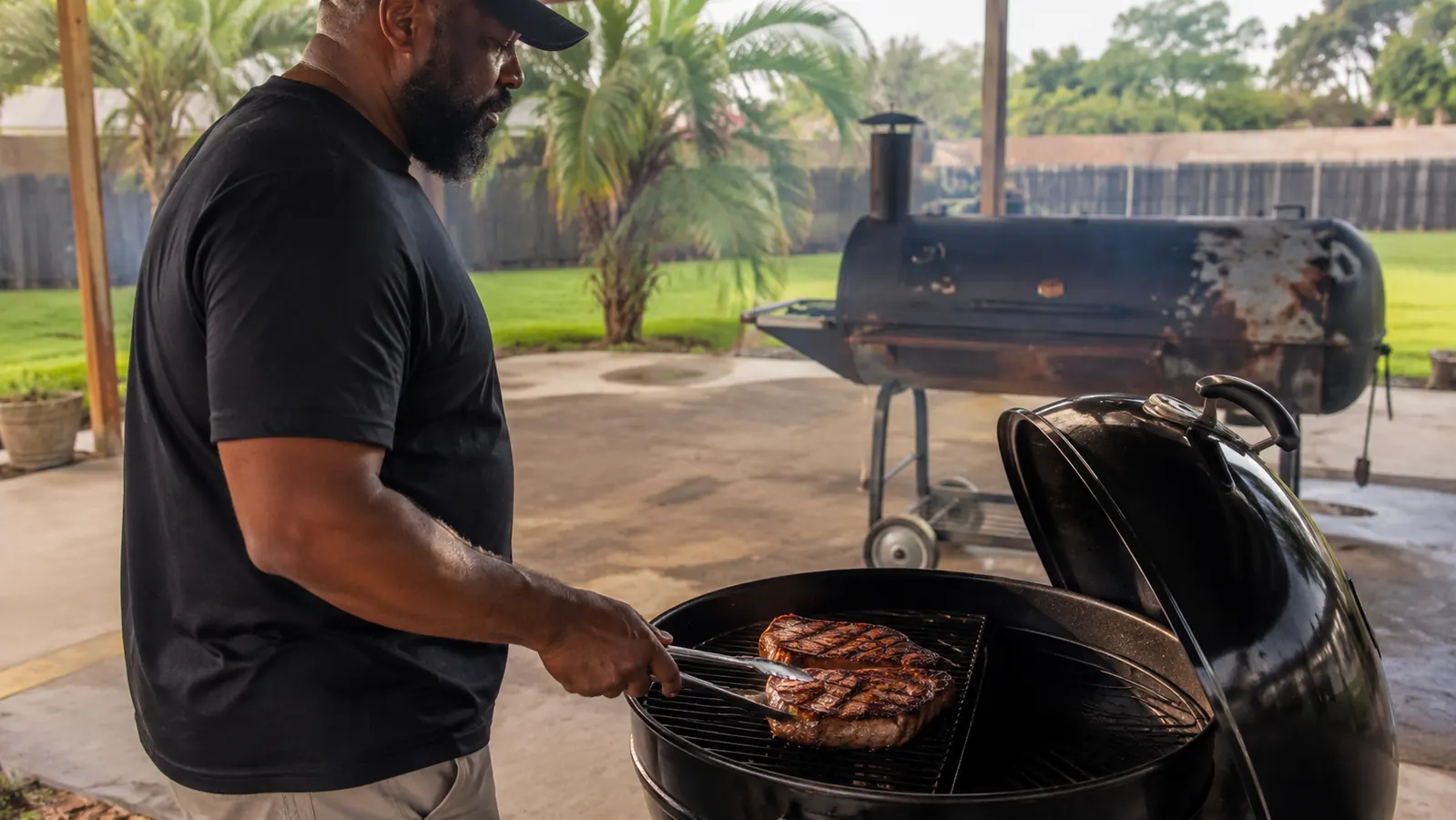
Last April, on a Tuesday that had no business being a special occasion, I laid two ribeyes on my 22.5-inch Weber kettle and pulled them off looking pale and gray instead of that deep mahogany crust you get at a steakhouse. Marisol didn't say anything, but I caught her eyeing the pan in the kitchen like she was thinking about finishing them under the broiler. That was the night I finally ordered the Weber Gourmet BBQ System sear grate, the porcelain-enameled cast iron half-moon insert that replaces one side of the stock cooking grate on Weber kettles. It's been locked into my kettle for exactly a year now, through steak nights, burger nights, and every reverse sear I've run off the Slow 'N Sear basket sitting on the other side of that same grill. This is what a full year of actual searing, not one good cookout, taught me about it.
I should mention I don't buy accessories casually. That same kettle already carries a Slow 'N Sear basket for low and slow cooks, and I've got a used offset stick burner out back that I bought secondhand and had to reseason and patch before it held smoke worth trusting. Adding a second grate insert felt like one more thing to store and one more thing to clean. But the stock chrome-plated wire grate that came with my kettle was never going to get me the kind of crosshatch marks I wanted on a ribeye, no matter how hot I ran the coals. Cast iron holds heat differently than thin chrome wire, and that difference is the entire reason the Weber sear grate exists. A year in, I can tell you exactly where that difference shows up and where it doesn't.
The Quick Verdict
After a full year of steak nights and Sunday burgers, the Weber sear grate earns its permanent spot on half my kettle. It genuinely changed how my steaks look and taste, and it needs more babying than the stock grate did to keep the porcelain looking new.
Amazon Check Today's Price →Tired of Pale, Streaky Sear Marks on a Grill That Should Do Better?
The Weber Gourmet BBQ System sear grate replaces half your stock grate with porcelain-enameled cast iron built to hold real searing heat. See today's price and current availability on Amazon.
Amazon Check Today's Price on Amazon →How I've Used It
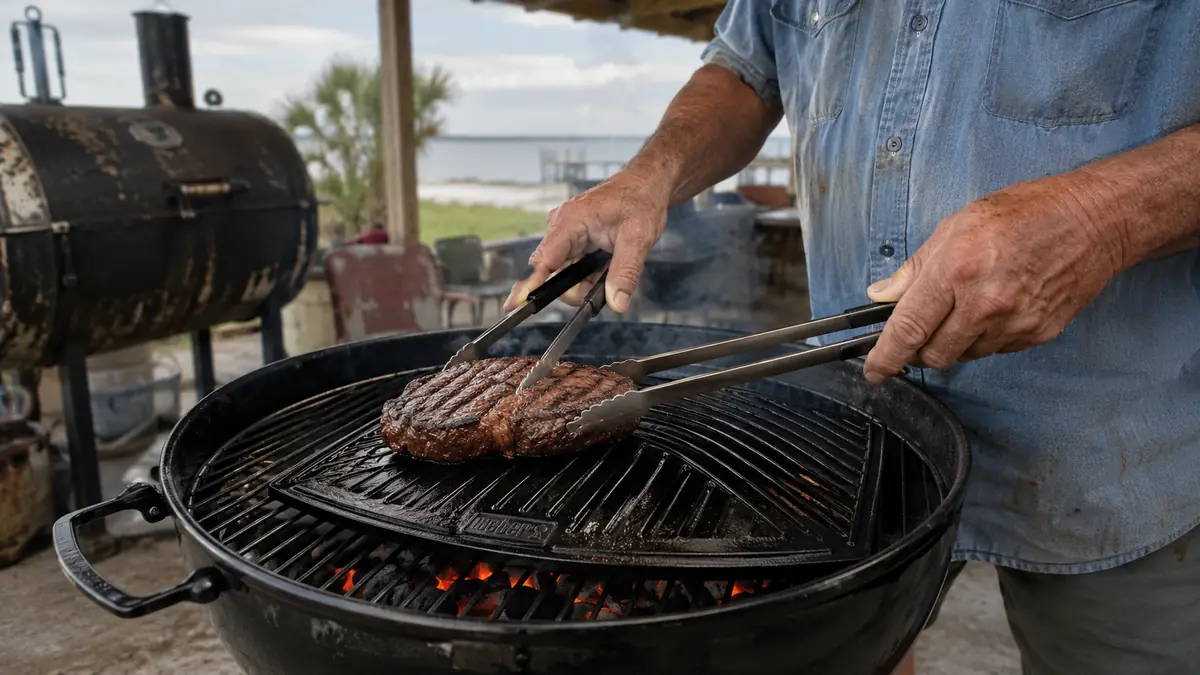
My cooking happens on a concrete patio slab behind the house, a few blocks off Ocean Drive, under a lean-to Beto helped me build a couple of summers back. The Weber sear grate takes up one half of the 22.5-inch cooking grate, the same size as my kettle, and the Slow 'N Sear basket runs on the charcoal side directly underneath it. That pairing wasn't an accident. I bought the sear grate specifically to finish what the basket starts, cooking low and slow on the cool side, then sliding the meat over to that cast iron half for the last few minutes to get real color instead of the faint gray stripes I used to get off the stock wire grate.
Between cooks, the sear grate comes off the kettle and goes into the same plastic tote in the garage where I keep the Slow 'N Sear and my chimney starter, though I wrap this piece in an old shop towel first. Porcelain chips if it knocks against something metal, and I learned that the hard way when it slid against the tote's other contents on a bumpy car ride to Hollis's place for a cookout and came back with a small chip on one corner. Now it gets its own spot, wrapped and set on top.
Steak night is the main event for this grate. Marisol and I do it most Tuesdays or Fridays now, just the two of us, two ribeyes or a couple of New York strips depending on what looked good at the store. When Kara, Beto, and the grandkids come through on a Sunday, the sear grate handles burgers for the crowd while the rest of the kettle runs whatever else is going, whether that's the tail end of a pork butt or just more burgers for Ruben, who at five years old still asks for his flat, no lines like the crosshatch marks are a texture he's not sold on yet. Tessa, on the other hand, has started asking to watch me rotate the meat to get the diamond pattern, which is about as close to a cooking lesson as an eight-year-old wants to sit through.
What Cast Iron Actually Changes About a Sear
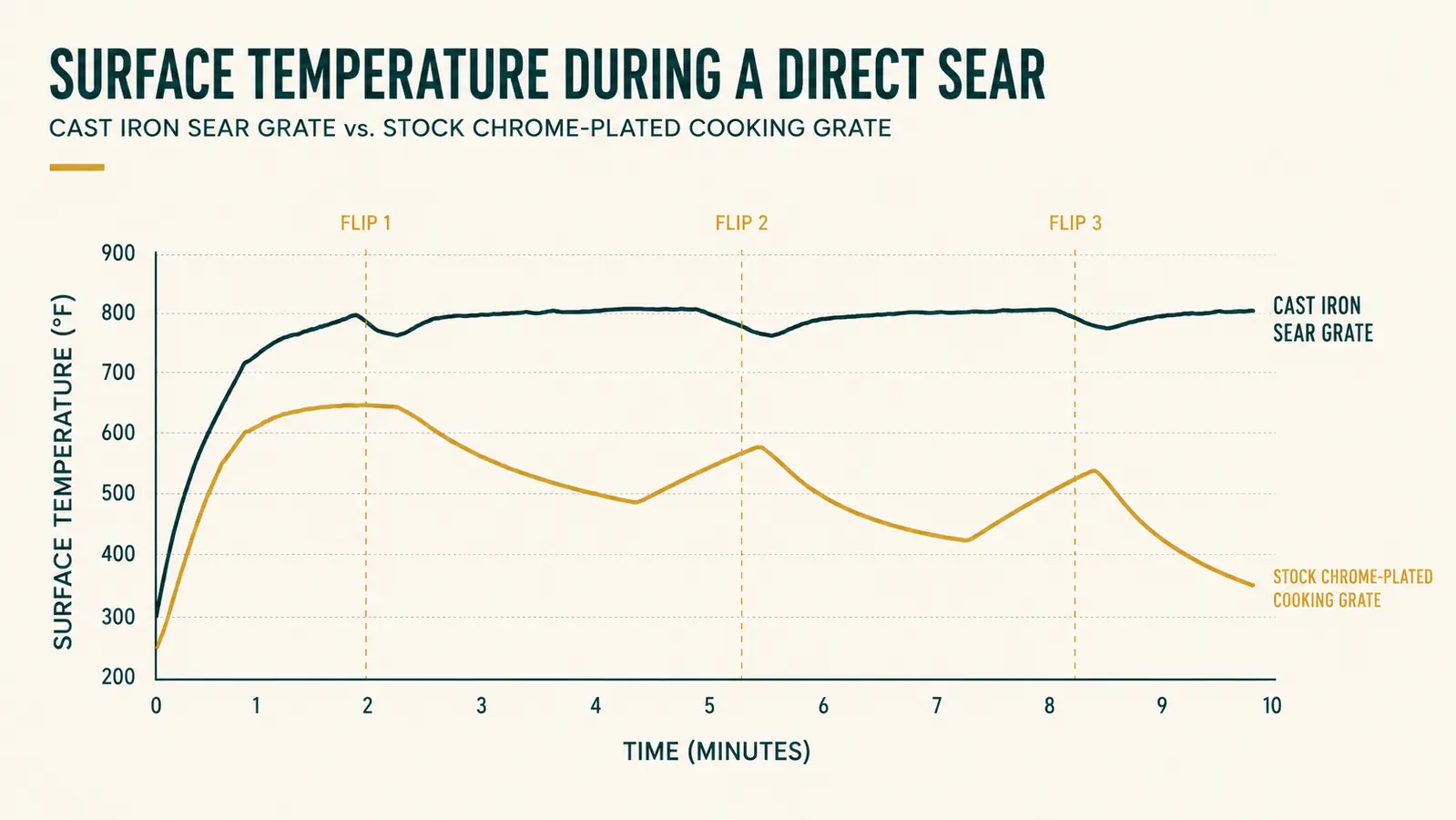
The short version is thermal mass. A thin chrome-plated wire grate heats up fast and cools down just as fast the moment cold meat touches it, which is exactly the problem I had before. Cast iron holds a much bigger reserve of heat, so when I lay a cold ribeye straight from the fridge onto the Weber sear grate, the surface temperature doesn't collapse the way it did on the stock grate. That reserve is what actually produces a real crust instead of the pale, streaky marks I was getting on Tuesday nights before I bought this thing.
The ridges themselves matter too. They're taller and more defined than the stock grate's thin wire, so the crosshatch pattern actually shows up dark instead of faint, and there's real contact pressure between the ridge and the meat rather than a light touch. I've written up the full side by side, including exact temperature numbers I logged with an infrared thermometer, in my comparison against the stock cooking grate, but the short version is that the gap is bigger than I expected before I owned one.
None of that means the fire underneath stops mattering. I still bank a good pile of hot coals directly under the sear grate, usually pulled over from the Slow 'N Sear once a cook is mostly done, or lit fresh in a chimney for a pure steak night. Cast iron amplifies whatever heat you give it, it doesn't manufacture heat on its own, so a lazy fire under the Weber sear grate still gives you a lazy sear. If you want the exact method I use to time the flips and get an even crosshatch, I laid it out step by step in a separate guide to getting steakhouse sear marks with cast iron.
A Year of Salt Air on Porcelain-Enameled Cast Iron
This is where I have to be honest instead of just enthusiastic. Living close enough to the bay that I can smell it most evenings, everything metal on my patio takes a beating, and the Weber sear grate is no exception. Porcelain enamel is a glass coating baked onto the cast iron, and it does a genuinely good job protecting the metal underneath from rust, better than my old stock grate ever did. But it isn't invincible. That chip from the car ride exposed a small patch of bare iron on one corner, and within a couple of humid weeks I could see a faint rust ring forming right there if I didn't stay on top of it.
The fix has been simple but it's an extra step nobody mentions in the product listing. After every cook, once the grate cools, I wipe it down, hit it with a little oil on a paper towel, and make sure it's fully dry before it goes back in the tote. Skip that even once during a stretch of Gulf Coast humidity and you'll see it. I go into the full maintenance routine, including exactly what I use to keep the chip from spreading, in the honest review I wrote after living with the rust spot for a few months. Short version here: the porcelain coating is genuinely tougher than I expected, but treat it like the stock grate and it will let you know.
Pairing It With the Slow 'N Sear for Reverse-Sear Sundays
The best cooks I've done all year use both pieces of gear at once. A thick-cut ribeye or a tri-tip goes on the cool side of the kettle low and slow, sometimes for close to an hour depending on thickness, then moves across to the Weber sear grate over the hottest coals I've got for two or three minutes a side. That's a real reverse sear, and it's the reason I bought this grate in the first place instead of just cranking the whole kettle hot and hoping for the best.
What surprised me is how much more forgiving that combination is on a windy evening, and Corpus Christi doesn't do many evenings without wind. The low and slow side stays protected inside the basket the way it always has, and the sear side, being a much smaller surface and a much shorter window, is easier to shield with my body or a quick lid crack than trying to manage a full hot kettle the whole cook. Steak night has gotten a lot less stressful since I stopped trying to do it all with one temperature.
Alternatives I Considered
Before I bought the Weber grate, I tried just running the stock grate hotter, piling coals under one side and calling it a makeshift hot zone. It sort of worked, but the marks stayed faint and the meat cooled the metal off too fast to hold real heat between flips. I also thought about just tossing a cast iron skillet on the grate instead of buying a purpose-made insert, and honestly, that works fine for a smash burger, but a flat skillet doesn't give you the ridges, and it takes up the whole cooking surface instead of leaving room for anything else. The half-moon shape of the Weber grate lets me run a hot zone and a cooler zone on the same 22.5-inch kettle at the same time, which a full skillet can't do.
I looked briefly at generic aftermarket cast iron grates from smaller brands too, mostly because they run a little cheaper, but the fit on a Weber kettle wasn't guaranteed, and after the trouble I went through getting my secondhand offset smoker to season and seal properly, I didn't want to gamble on a grate that might rock or sit unevenly. Buying the piece actually made to fit my grill removed one more variable I didn't need to think about.
What I Liked
- Holds real searing heat that the thin stock chrome grate can't match, especially on cold-from-the-fridge steaks
- Deep, well-defined ridges produce actual dark crosshatch marks instead of faint stripes
- Half-moon size lets me run a hot sear zone and a cooler zone on the same kettle at once
- Pairs naturally with a two-zone low and slow setup for real reverse-sear cooks
- Porcelain coating resists rust noticeably better than bare cast iron would in salt air, as long as it stays intact
Where It Falls Short
- Porcelain will chip if it knocks against something hard, and a chip exposes bare iron that rusts fast in Gulf Coast humidity
- Needs an oil wipe-down and full drying after every single cook, more upkeep than the stock grate ever asked for
- Heavier to lift out and carry than the wire grate it partly replaces
- Only covers half the cooking surface, so you still need the rest of the stock grate in place
The stock grate never lied to me about how hot my fire was. The Weber sear grate is the first piece of gear that finally matched the fire I was actually building.

Who This Is For
If you're already running a two-zone setup on a 22.5-inch Weber kettle and you've been disappointed by pale sear marks no matter how hot you run your coals, this is the piece that closes that gap. It's especially worth it if steak or burger night is a regular fixture at your house the way it is at mine, because the improvement shows up every single time, not just on special occasions. I run through more of the everyday reasons it earns a permanent spot in my list of what a cast iron sear grate actually changes about a normal cook.
Who Should Skip It
If you mostly smoke low and slow and rarely do a hard direct sear, you probably won't get enough use out of this to justify the extra cleaning routine. And if you live somewhere dry where rust has never been a concern for you, some of my caution here about the porcelain chip might read as more work than it actually is for your climate. Out here on the coast, staying on top of it is just part of owning nice grill gear.
Ready for Steak Marks That Actually Look Like a Steakhouse?
A year in, this is still the piece of gear that changed the most about steak and burger nights at my house. Check today's price on Amazon and see if it fits your kettle.
Amazon Check Today's Price on Amazon →