
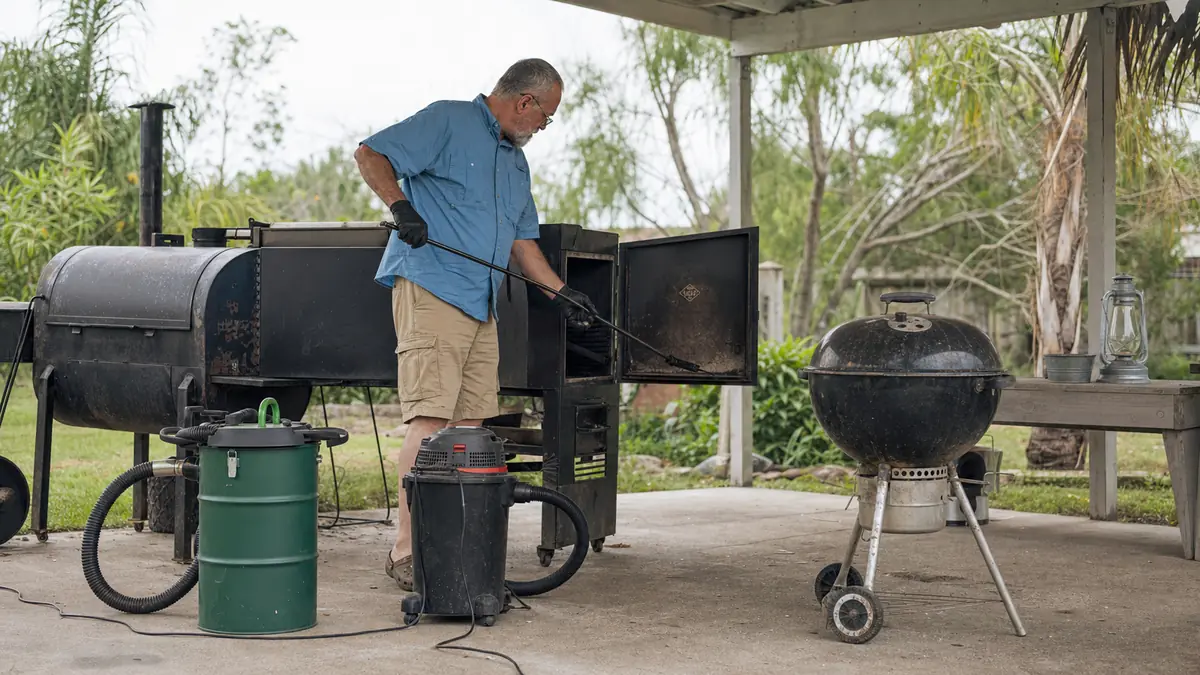
If you're standing in your garage right now looking at the shop vac you already own and wondering whether you really need a separate machine just for ash, I've been exactly where you are. Short answer: for cooled ash out of a kettle or an offset firebox, the PowerSmith ash vacuum is the safer, faster tool and it's what I actually reach for every week now. But I'm not going to pretend a shop vac is useless around a grill setup, because it isn't. It's more versatile, it's usually cheaper to replace if something goes wrong, and most of us already own one sitting in the garage. This is the honest side by side, built from fourteen months of running the PowerSmith against the plastic shop vac I used for years before it, on the same 22-inch kettle and the same secondhand offset stick burner.
I didn't set out to become the guy who owns two vacuums for two different jobs. For years, one shop vac in the garage covered everything, sawdust from patching the offset's firebox back when I first bought it secondhand, spilled charcoal, the odd leaf pile Marisol asked me to deal with before a Sunday cook. It never occurred to me that a dedicated ash vacuum was a real category of tool and not just a marketing gimmick aimed at people with more money than sense. Once I understood why fine, cooled ash behaves so differently from sawdust inside a vacuum, the decision got a lot easier, and I kept the shop vac around for everything else instead of retiring it.
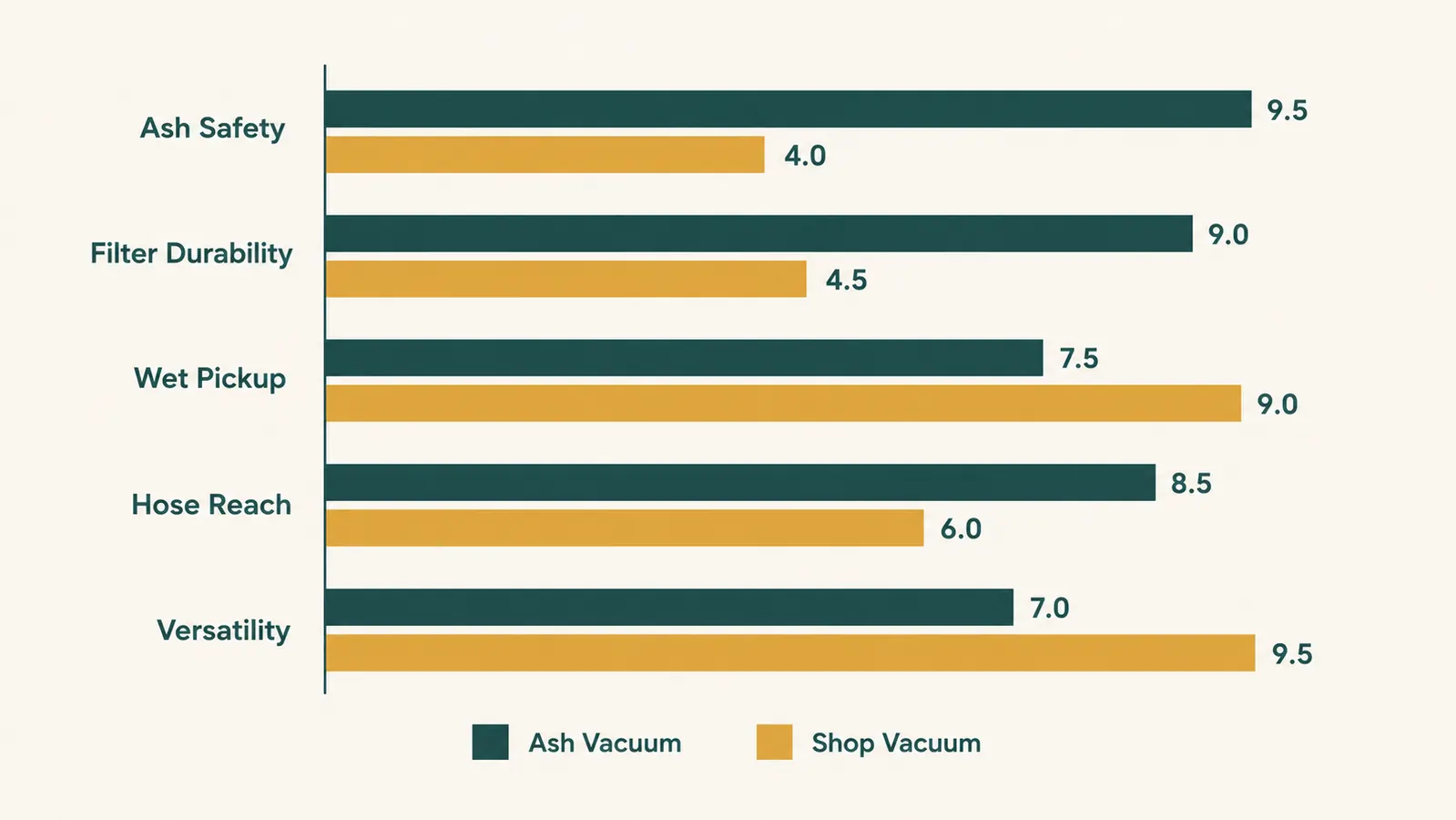
| PowerSmith Ash Vacuum | Shop Vacuum | |
|---|---|---|
| Canister Material | Metal canister rated for cooled ash and fine particulate | Plastic canister, built for sawdust and wet debris |
| Filter Type | Heavier gauge filter designed to resist fine ash clogging and scorching | Standard paper or foam filter bag, not rated for ash or embers |
| Tank Capacity | Smaller canister, built for ash volume only | Larger tank, often five gallons or more |
| Hose Length and Reach | Shorter hose, a bit tight on a full-size offset firebox | Longer hose on most models, easier to reach tight corners |
| Wet Pickup | Not designed for water or liquid spills | Handles wet pickup, spills, and general shop cleanup |
| Everyday Versatility | Single purpose, ash and cooled coals only | Sawdust, garage debris, water, leaves, general cleanup |
| Safety Margin on Cooled Ash | Built specifically to reduce fire and scorch risk from ash and stray embers | Genuine fire risk if ash isn't fully cold, filter and housing not rated for it |
| Cleanup Time on an Offset Firebox | About fifteen to twenty minutes for a full clean-out | Closer to forty five minutes, plus more dust in the air |
| Already Own One | A dedicated purchase most people don't already have | Most households already own a general shop vac |
Where the Shop Vacuum Wins
I want to be straight with you here, because a comparison where one product wins every single row isn't honest, it's just an ad wearing a chart. A regular shop vac earns its place in a lot of garages, and there are real categories where it beats a dedicated ash vacuum outright. Capacity is the obvious one. My old shop vac had a five gallon tank, big enough to run through a whole weekend of garage cleanup, downed leaves, and sawdust from a woodworking project without emptying it once. The PowerSmith's canister is smaller by design, because it's meant for ash volume, not for filling up with general debris.
Hose reach matters more than I expected too. My shop vac's hose was long enough that I could stand in one spot and clean out most of the garage without repositioning. The PowerSmith's hose does the job on the kettle without complaint, but reaching the far corners of my offset firebox takes some crouching and shifting around, especially with an outdoor extension cord already limiting how far I can wander from the outlet. And then there's wet pickup. A shop vac handles a spilled bucket, a leaky cooler, rain that got into the tool shed, all the general mess a household generates. An ash vacuum has no interest in any of that. If you've only got room in your budget or your garage for one machine and your needs are broader than ash, a general shop vac is the more useful tool day to day, full stop.
Cost and replaceability play into this too. If a shop vac's motor burns out or the hose splits, replacement parts and whole units are everywhere, and you're not hunting for a specialty part built for one narrow job. A shop vac also earns its keep outside of grilling season entirely, garage floor sweep-ups, wet-dry cleanup after a Gulf Coast downpour finds its way under the shed door, sawdust from whatever project I'm working on that weekend. The PowerSmith sits idle between cookouts. That's fine with me, because ash cleanup is worth a dedicated tool in my book, but it's a real trade-off worth naming plainly before you spend money on a second machine.
Still Deciding? Here's the One Job a Shop Vac Genuinely Shouldn't Do.
A shop vac is the better all-around tool for most garage cleanup. But for cooled ash out of a kettle or an offset firebox specifically, the PowerSmith's metal canister and heavier filter are built for that exact risk. See today's price and current availability on Amazon.
Amazon Check Today's Price on Amazon →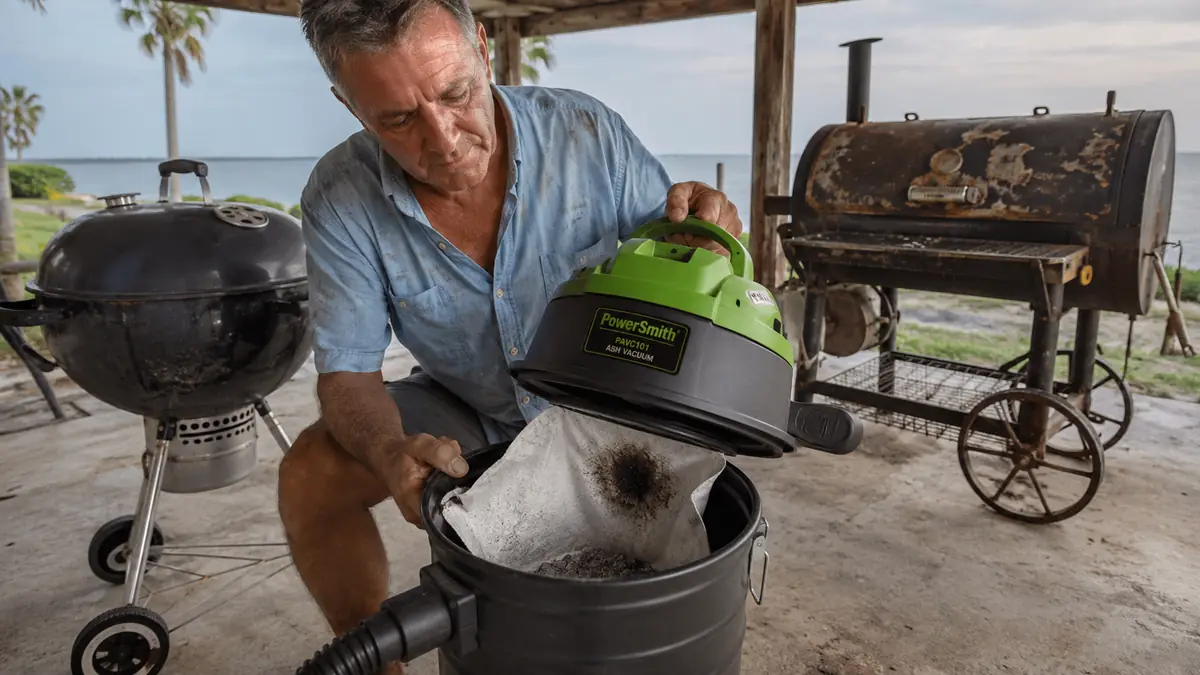
Where the PowerSmith Wins
The categories where the PowerSmith pulls ahead all trace back to one thing, ash behaves differently than the sawdust and household debris a shop vac was designed for. Fine ash is talcum powder fine. It gets past a lot of standard shop vac filters and either blows back out the exhaust in a cloud or packs into the motor housing over time. And if there's a stray ember buried somewhere in that pile that you thought was fully cooled, a plastic canister and a paper filter bag are exactly the wrong things to have anywhere near it. I know that because it happened to me. I thought a pan of ash from the night before was cold. It wasn't, not all the way through, and I watched a scorch mark spread across the inside of my shop vac's filter bag before I got the cord yanked out of the wall. Two days of my garage smelling like a dead campfire followed.
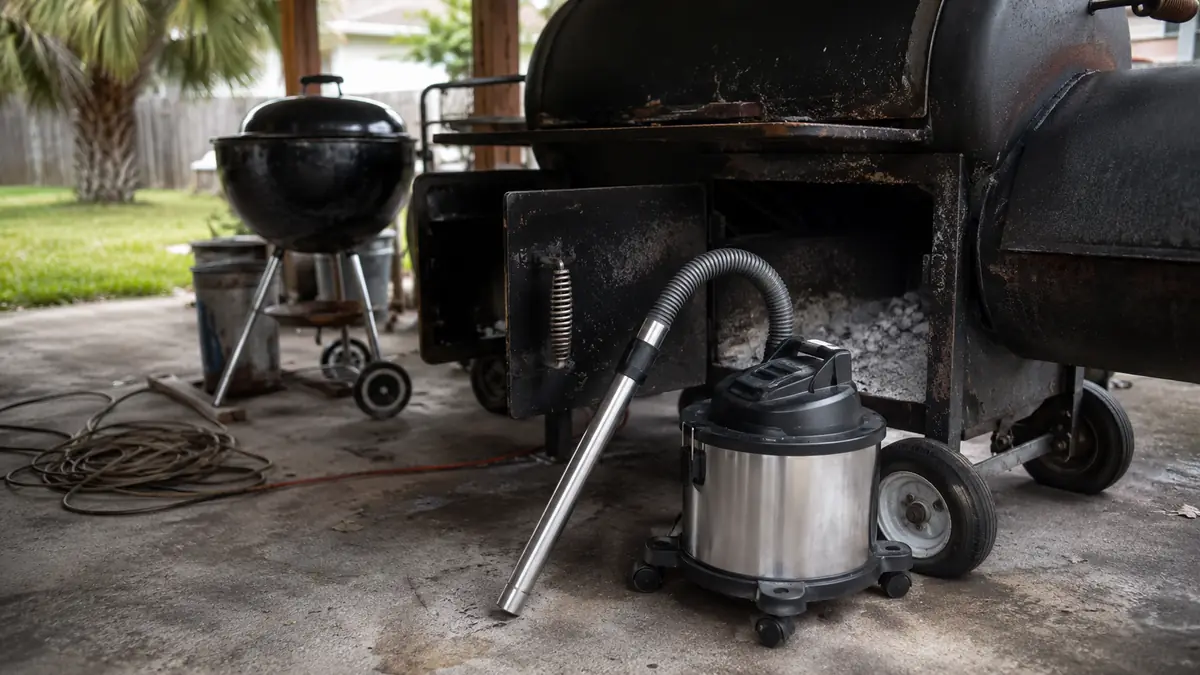
That scare is the entire reason a PowerSmith ash vacuum lives on my garage shelf now instead of a second shop vac. The metal canister and the heavier filter aren't marketing dressing, they're the actual reason the tool exists, and they cut real risk compared to running fine ash through equipment built for sawdust. Cleanup speed follows from that same design. A full offset firebox used to take me close to forty five minutes with a dustpan and my old shop vac, coughing through a cloud of fine dust half the time. With the PowerSmith it's fifteen to twenty minutes, and I'm not breathing nearly as much of it. I've written the full walkthrough of that routine, step by step, over on cleaning out an offset smoker with an ash vacuum if you want to see exactly how it goes.
The design details back that up when you actually look at them side by side. The rigid metal tube on the end of the PowerSmith's hose scrapes along a firebox floor and pulls ash and clinker toward the intake instead of flexing away from it the way a soft plastic hose does on my old shop vac. That sounds like a small thing until you're on your knees trying to coax the last of the fine powder out of a corner. A soft hose just pushes it around. The rigid tip actually collects it, and that difference alone saved me a good five minutes on every offset clean-out, on top of everything the filter and canister were already doing.
The Real Fire Risk Nobody's Marketing Copy Mentions
Here's the part that matters more than either machine's spec sheet. Neither an ash vacuum nor a shop vac makes ash safe to vacuum on its own. That call is entirely on you, and it's the one I got wrong before I owned the PowerSmith. My rule now is a minimum of twenty four hours after the last coal goes out, and out here on the Gulf Coast where humidity is a fact of life, I usually give it closer to forty eight, because damp ash holds heat differently than dry ash does. A pile that looks gray and dead on top can still have a warm coal sitting an inch down where you can't see it.
Before I run either vacuum, I push an old retired meat thermometer down into the deepest part of the ash pile. If it doesn't read close to room temperature, I close the firebox door and walk away for another day, no exceptions. My neighbor Hollis thinks I'm overly cautious about it, especially when he's hoping to get the offset going again on a Saturday. I don't care. A canister full of hot embers and fine dust, whether it's metal or plastic, is a real fire risk, and no amount of convenience is worth a garage fire. A dedicated ash vacuum lowers the odds if you do misjudge it slightly. It doesn't erase the risk of vacuuming ash that's still genuinely hot.
A dedicated canister and a better filter are the reason I trust this job more than I used to. They're not a reason to skip checking the ash first.
Who Should Buy Which
If you cook on a charcoal kettle or a stick burner offset on any kind of regular schedule, the way I do most Sundays for Kara, Beto, and the grandkids, the PowerSmith earns its shelf space. The time you save on a full offset clean-out alone, cutting a forty five minute chore down to fifteen or twenty, adds up fast over a grilling season, and you get a real safety upgrade on top of that for a job that genuinely carries fire risk. I go through more of the specific reasons it's worth owning in 10 reasons an ash vacuum belongs in your grill shed, and the longer season-by-season read is over in my full PowerSmith review after fourteen months of use.
If you've got a small gas grill with barely any ash to speak of, or you cook so rarely that a dustpan every couple of months handles it fine, you don't need a second machine for this. Keep your shop vac, be careful about ash temperature, and save the money. And if a general shop vac is the only vacuum in your garage right now and you're not ready to buy a second one, that's a reasonable place to be as long as you're strict about letting the ash go fully cold, checking it, and never trusting a pile that looks gray on top. The PowerSmith didn't make me careless about hot ash. It made the after part of the job fast enough that I actually do it every week instead of putting it off, and that's really the case for it in one sentence.
Hollis ended up going a different way than me. He kept his shop vac for now and just got stricter about checking ash temperature before every clean-out, and for someone who only fires up his smoker once or twice a month, that's a reasonable call. I run two grills most weekends of the year, so paying for a dedicated tool made sense a lot faster for me than it might for him. Weigh your own cook schedule before you decide, not mine, and don't feel like you have to own both to do this safely.
Ready to Retire the Dustpan and the Repurposed Shop Vac?
Fourteen months in, the PowerSmith is still the tool that gets my offset cleaned on schedule instead of putting it off. Check today's price on Amazon and see if it's in stock.
Amazon Check Today's Price on Amazon →