
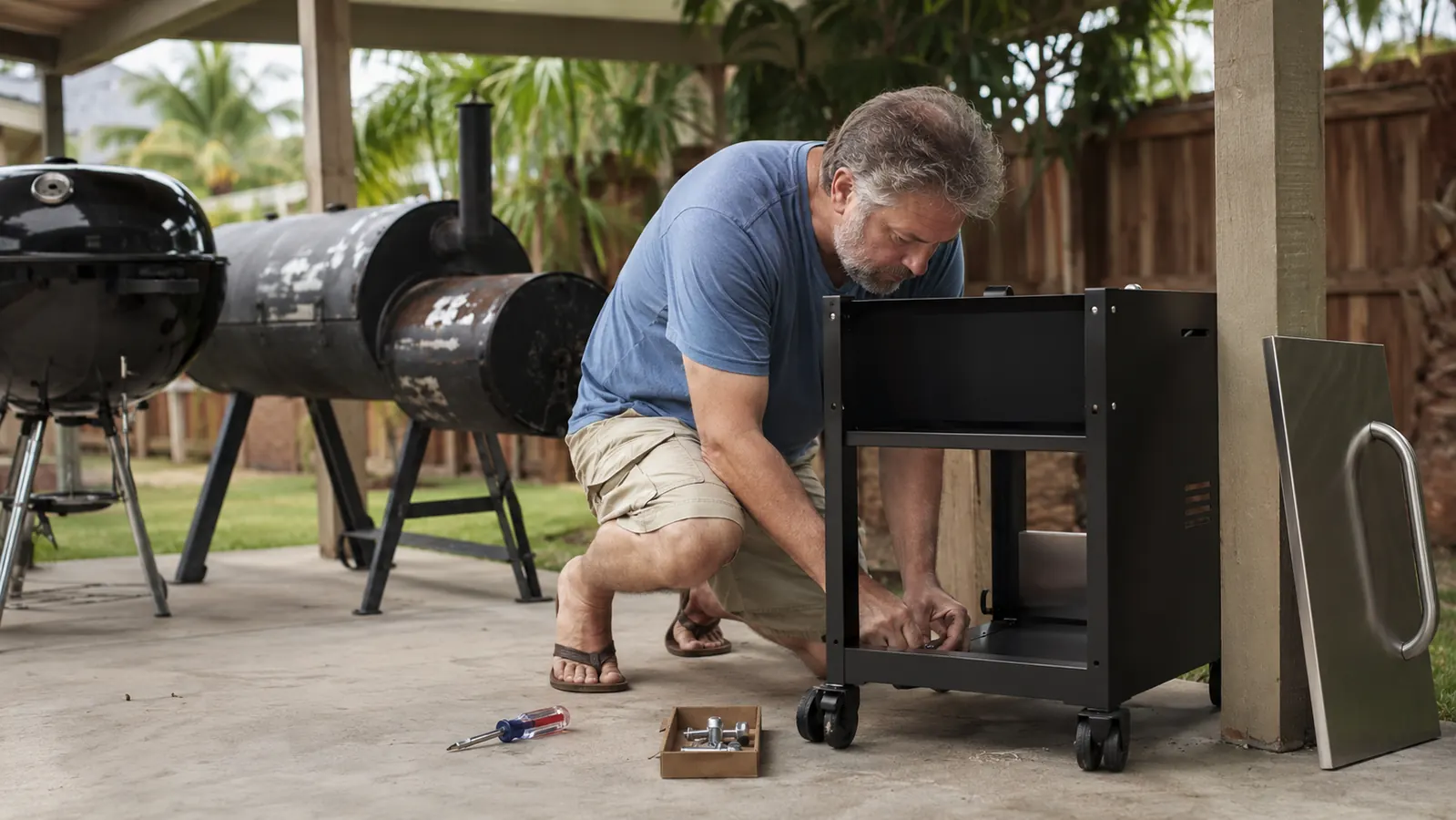
Every review I'd read of the Royal Gourmet PC3404S rolling prep cart before I bought mine started with the stainless top and ended with a happy photo on a clean patio, and that's fine as far as it goes, but nobody told me what the first week actually looks like, or what a year of Gulf Coast salt air does to the parts nobody photographs. I've had this cart parked between my grills for about a year now, since the week my old card table finally gave out under a rack of ribs. I told that whole story in my long-term review of this same cart, and if you want the full year-in-the-life account, that's the place for it. This piece is different. This is the one where I stop selling you the highlights and just tell you what nobody tells you upfront.
I cook on a 22-inch charcoal kettle I've had for years and a used offset stick burner I bought secondhand, and I've run this Royal Gourmet cart hard between the two of them for twelve months of Sunday cooks, most weeks feeding six people and sometimes twelve when my neighbor Hollis wanders over with his crew. So this isn't a first-impressions review. This is assembly reality, salt air rust, the trash bag holder question everybody asks and nobody answers honestly, and the tradeoff between stability and weight that the product photos can't show you.
The Quick Verdict
Solid cart, real problem solved, but the listing photos leave out three things you should know going in: assembly wants two people, the hardware needs real maintenance near salt air, and the weight that makes it stable also makes it a chore to move off a rough surface.
Amazon Check Today's Price →Want the Real Story Before You Click Buy?
I'm not going to tell you this cart is perfect. I'm going to tell you exactly what a year of ownership actually looks like, then let you decide. Check today's price and current availability on Amazon.
Amazon Check Today's Price on Amazon →How I Actually Tested This Cart
I didn't just use the Royal Gourmet cart the way it showed up in the box and call it a review. Over the past year I've loaded it past what most people probably would, stacking a full brisket, two pans, a stack of plates, and a drink cooler on the top at once during one particularly ambitious Thanksgiving cook, just to see if the frame would flex or the casters would bind. I've left it uncovered through stretches of wet weather on purpose in the early months, before I got smart about it, specifically to see how fast the hardware would show wear. I've rolled it across every surface my patio offers, smooth concrete, a rough seam, and the edge of my grass line, more times than I could count.
I also checked the bolts and caster axles by hand roughly once a month, which is more attention than a normal owner probably gives a prep cart, but it's the only way I could tell you with any confidence when the rust actually starts and how fast it moves. None of that is scientific. It's just a stubborn Gulf Coast retiree with a screwdriver and a habit of paying close attention to gear that lives outside.
What that testing gave me is a timeline instead of a snapshot, and a timeline is the only thing that actually tells you what you're buying.
Assembly Is Not the Forty-Five-Minute Job the Box Implies
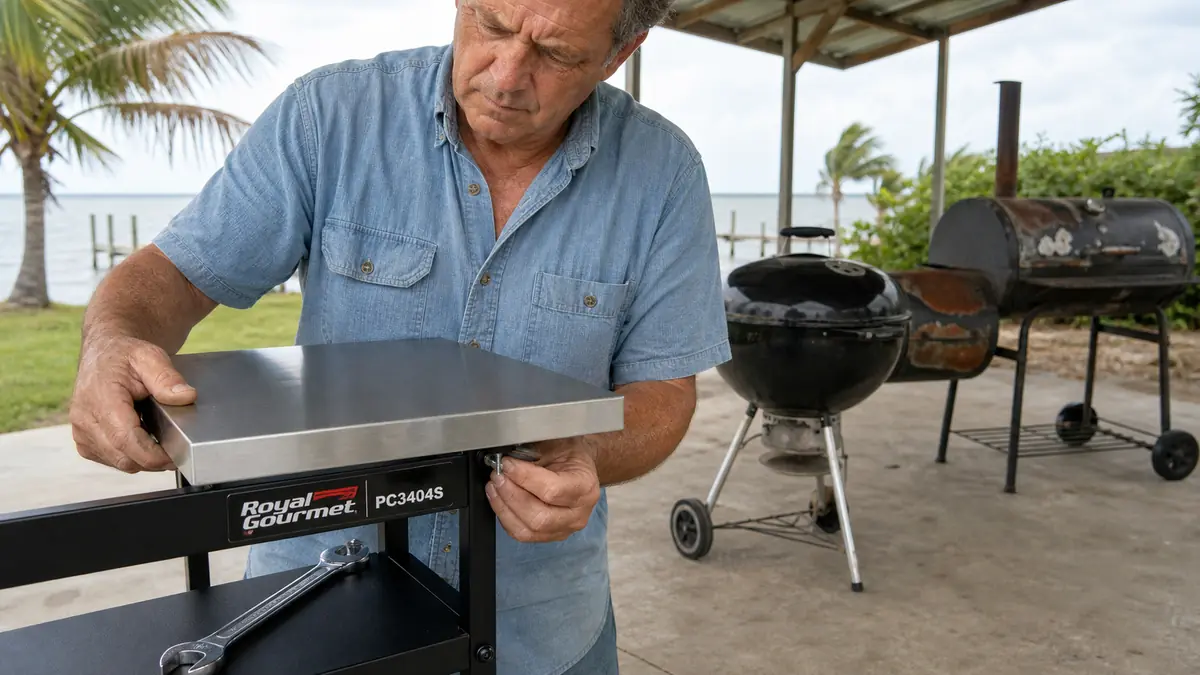
The instructions that come with the Royal Gourmet cart make it look like a solo Saturday morning job, and technically it is. I got it done in about forty five minutes with a Phillips head screwdriver and the wrench included in the box. What the instructions don't say clearly enough is that the stainless steel tabletop panel is heavier and more awkward than it looks in the pictures, and lining up the bolt holes on the frame while also holding that panel level is genuinely a two-person task if you want to do it without scratching anything or stripping a hole.
I did mine alone the first time and regretted it about fifteen minutes in, wedging one edge of the top against my knee while I fumbled a bolt into place one-handed. The second time I had to reassemble a section after moving the cart to a different spot on the patio, I asked Marisol to hold the panel steady while I ran the bolts, and it took a third of the time with half the frustration. If you're setting one of these up and you live alone or you're doing it while everyone else is inside getting the sides ready for a cook, budget extra time and don't be too proud to ask for a hand.
The other thing nobody mentions is clearance from your heat source. I parked my Royal Gourmet cart right up against the kettle the first week because it seemed convenient, and within a couple of long cooks the powder coat on the corner nearest the firebox had picked up a faint discoloration from the heat. I moved it back about three feet and haven't had the problem since, but that's a mistake you only make once, and I'd rather you skip it entirely.
What Powder-Coated Steel Actually Does This Close to Salt Air
This is the section most reviews skip entirely, and it's the one that matters most if you don't live somewhere dry. The stainless steel top on the Royal Gourmet cart genuinely does hold up. A wipe with stainless cleaner every few weeks keeps it looking close to new, and I've never seen it pit or stain, even after a greasy pulled pork cook sits on it overnight before I get around to wiping it down.
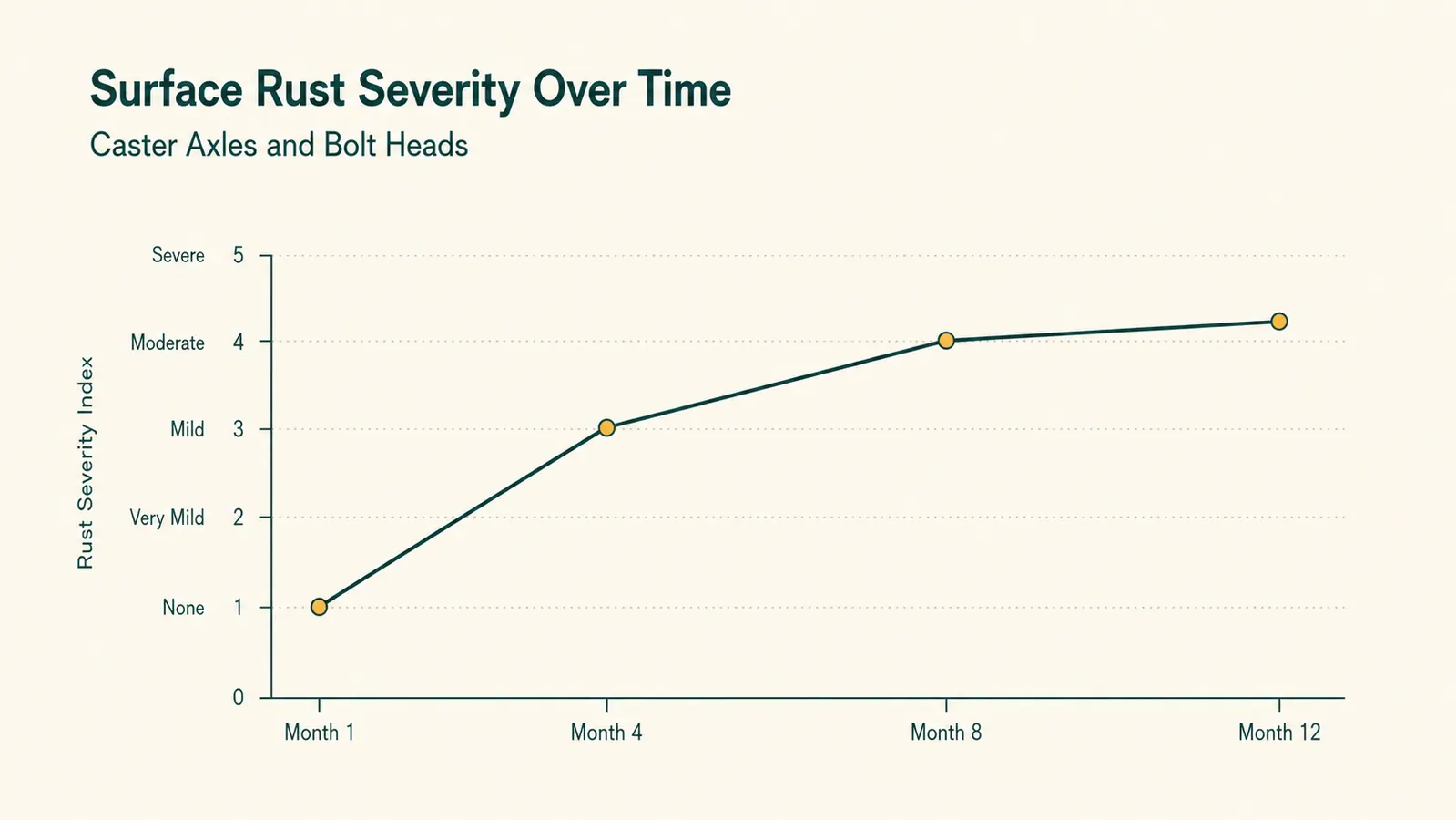
The frame and hardware are a different conversation. Living a few blocks off Ocean Drive means everything metal on my patio takes a beating from salt in the air, and this cart isn't exempt just because the top is stainless. I started seeing surface rust on a handful of the bolt heads by month four. By month eight, two of the four caster axles had picked up enough corrosion that they'd started squeaking noticeably under any real load, the kind of sound that makes you wince a little every time you roll it across the slab.
Some of that timeline is on me, since I left the cart out uncovered through a stretch of wet weather early on before I started taking a fitted cover seriously. Once I got disciplined about covering it overnight and spraying the caster axles with a light coat of silicone lubricant every couple of months, the squeaking stopped and the rust slowed down, but it never fully reversed and it never fully stopped either. That's just the tax of keeping powder-coated steel outside near open water. If you're further inland or in a dry climate, you'll likely see almost none of this. If you're anywhere near a coast, budget fifteen minutes a month for hardware maintenance, because the listing photos will never mention it and the product itself won't either until the squeak shows up.
Humidity does its own quieter damage too. Anything stored loose in a paper bag on the wire shelf underneath the Royal Gourmet cart, charcoal especially, picks up moisture faster here than it would somewhere dry. I switched to sealed containers on that shelf months ago and it solved the problem completely, but it's an adjustment you have to make yourself, because nothing in the box tells you the shelf isn't sealed against moisture.
Is the Trash Bag Holder a Gimmick or Does It Actually Work
I'll admit I was skeptical about the built-in trash bag holder before this cart showed up. It reads on the product listing like exactly the kind of feature a manufacturer adds to make a plain prep cart sound more thought out, a bullet point with no real substance behind it. A year of use changed my mind completely.
Before I had it, I set a grocery bag on the ground next to the grill for scraps and trimmings, and I kicked it over at least twice a season, usually at the worst possible moment with a plate of raw chicken in my other hand. Since the Royal Gourmet cart's holder has been in service, that hasn't happened once. It's a wire frame that a standard kitchen bag hooks over, sturdy enough that it doesn't sag or tip when the bag fills with trimmings and used foil, and it's low enough on the cart that Ruben, my five-year-old grandson, can point at it and tell me when it needs changing, which he does with real enthusiasm.
It's not a complicated feature and it's not going to sell you on the cart by itself, but it solves a genuinely annoying problem I'd lived with for years without realizing there was a simple fix. Not every gimmick-sounding feature turns out to be a gimmick, and this is the rare one that isn't.
The Weight and Stability Tradeoff Nobody Mentions
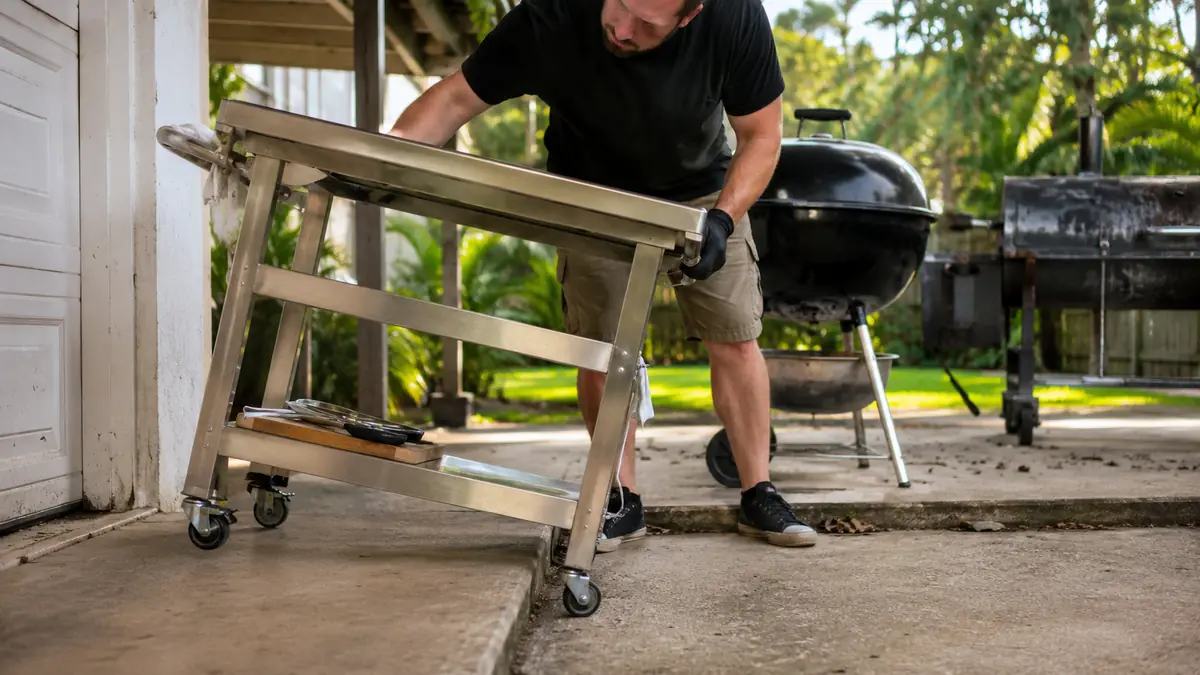
The Royal Gourmet cart is heavy enough, especially once you've loaded the top and the wire shelf underneath, that it doesn't tip or wobble even when the wind is doing what Gulf wind does to everything on my patio. That's a real advantage. A lighter folding table would catch a gust and go over, and I've had that happen with cheaper gear before. The tradeoff is that same weight makes the cart genuinely tiring to muscle across anything that isn't smooth, flat concrete, especially once you've stacked a brisket, a couple of sauce bottles, and a drink cooler on top of it.
Two of the four casters lock, which helps once the cart is where you want it, but getting it there in the first place, particularly loaded, takes real effort compared to something lighter and flimsier. If your patio has any slope to it at all, or if you're planning to roll this thing across grass or gravel rather than a poured slab, that weight stops being an asset and starts being a real limitation. I wouldn't want to move a fully loaded Royal Gourmet cart uphill on anything but concrete, and I say that as someone who's tried it.
The seam where my patio slab meets the walkway to the garage is the one spot that reminds me of this every single cook. There's about a half inch lip there, and the front casters catch on it more often than I'd like. I've learned to tilt the front of the cart up slightly as I cross it, which works fine once you know to do it, but it's exactly the kind of thing a product listing will never warn you about because it depends entirely on your own patio, not the cart.
When You Should Honestly Just Build Your Own
I thought seriously about building a prep table myself before I bought this one, out of scrap lumber and a sheet of stainless from the hardware store, the way I've built a few other things around this house. If you already have the tools, the time, and materials sitting around, a DIY build can genuinely come out ahead, and I laid out the full comparison in a separate piece on a rolling cart against a DIY prep table if you want the complete breakdown of where each one wins.
But the honest version of that comparison is this: I underestimated how long a from-scratch build would actually take me, and I still would have needed to source casters, a trash solution, and a stainless surface on my own, which adds up to more weekend work than most people want to sign up for. If your Saturdays are already full, or you don't have a stocked garage workshop, the Royal Gourmet cart gets you a workable version of the same idea in an afternoon instead of a month of evenings. I put together a fuller rundown of what a cart like this changes day to day in ten reasons a rolling prep table fixes your grill station and a step-by-step layout in how to organize a backyard grill station with a rolling cart, if you're still deciding which route makes sense for your own setup.
What I Liked
- Real stainless steel top handles hot pans and wipes clean, and held up spotless for a full year
- Trash bag holder is a genuine daily fix, not the gimmick it sounds like on the listing
- Heavy enough that Gulf Coast wind never tips it, even loaded
- Two lockable casters keep it steady once it's parked where you want it
- Assembly is doable solo in under an hour if you're patient with the top panel
Where It Falls Short
- Top panel genuinely wants a second pair of hands during assembly, the instructions don't say so
- Bolt heads and caster axles show surface rust within months near salt air, ongoing maintenance required
- That same stability weight makes it hard to muscle across anything but smooth concrete
- Front casters catch on small seams or lips more than you'd expect
- Wire shelf underneath isn't sealed, so loose bags of charcoal take on humidity
The stainless top never let me down once. It's the bolts, the axles, and my own impatience during assembly that taught me the real lessons.
Who This Is For
If you're running two cookers like I am, or you just want a real staging surface between the kitchen and the grill, and you're on a concrete patio or a flat, paved surface, the Royal Gourmet cart earns its keep. You'll get a year or more of reliable service out of it as long as you're willing to spend a few minutes a month on the hardware, especially if you're anywhere near a coast.
Who Should Skip It
If your setup is on grass, gravel, or a sloped patio, the weight that makes this cart stable will make it a chore instead of a convenience. If you're not willing to check bolts and axles occasionally or throw a cover over it between cooks, humid or salty air is going to catch up with the hardware faster than it did for me. And if you're assembling this alone with no one around to hold the top panel steady, go in knowing it, and it'll go a lot smoother.
Now You Know What the Listing Won't Tell You
Assembly, rust, and all. A year in, I'd still buy it again. Check today's price on Amazon and see if it's in stock.
Amazon Check Today's Price on Amazon →